

Why Does Ransomware Cause Business Disruptions?
Date : 07-10-2026
The Attack Process and Five Key Measures Every Organization Should Take

What If Your Business Suddenly Stopped on a Monday Morning?
Imagine arriving at work on a Monday morning and booting up your computer as usual, only to find that files cannot be opened and the ERP system is inaccessible. The accounting department cannot issue invoices, the purchasing department cannot check order statuses, and production-related systems are also experiencing failures. Then, a message appears on the screen:
"Your files have been encrypted. Pay within 72 hours to recover your data."
This is one example of the business disruption that can result from a ransomware attack. Ransomware impacts much more than just the files stored on PCs and servers. It can lead to business system outages, order and shipment delays, disruption of customer services, information leakage, and widespread effects across the entire organization
What Is Ransomware?
Ransomware is a type of malware that encrypts data on computers and servers, making it inaccessible and demanding payment in exchange for restoring access. In recent years, attackers have gone beyond simple encryption. Many now steal confidential information before encryption and threaten to publish the data unless a ransom is paid. This technique is commonly known as double extortion. As a result, even if systems can be recovered from backups, Organizations may still face information leakage, customer response requirements, regulatory compliance issues, and damage to brand reputation.
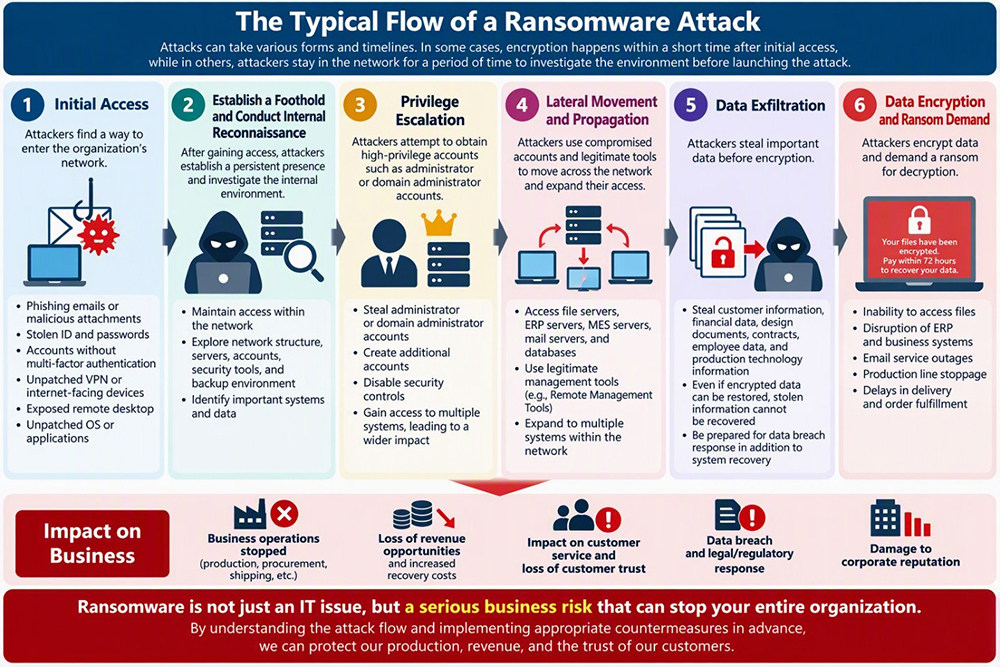
The Typical Stages of a Ransomware Attack
Not all attacks follow the same timeline. Some attackers begin encryption shortly after gaining access, while others remain hidden within the network for a period of time to investigate the environment before launching the attack. A typical ransomware attack can be understood through the following six stages.
Stage 1: Initial Access
Attackers look for entry points into the organization's network. Common entry methods include:
- Phishing emails or malicious attachments
- Stolen usernames and passwords
- Accounts without Multi-Factor Authentication (MFA)
- Unpatched VPNs and internet-facing devices
- Exposed Remote Desktop services
- Unresolved vulnerabilities in operating systems and applications
Organizations must not only strengthen email security but also identify and properly manage all internet-accessible systems and services.
Stage 2: Establishing a Foothold and Conduct Internal Reconnaissance
After gaining entry, attackers secure mechanisms that allow them to remain active within the environment. They then investigate network architecture, servers, user accounts, security tools, and backup systems to identify valuable systems and sensitive data.
Stage 3: Privilege Escalation
Attackers attempt to obtain privileged accounts such as IT administrator or domain administrator credentials. Once elevated privileges are acquired, they can create additional accounts, disable security controls, and access multiple systems, significantly increasing the impact of the attack.
Stage 4: Lateral Movement and Propagation
Attackers use compromised accounts and legitimate administrative tools to expand access to critical systems such as:
- File servers
- ERP servers
- MES servers
- Email servers
- ERP databases
In manufacturing environments, interconnected production, inventory, and purchasing systems can amplify the impact across the organization.
Stage 5: Data Exfiltration
Modern ransomware groups frequently steal sensitive information before encryption. This information may include:
- Customer data
- Financial records
- Engineering drawings
- Contracts
- Employee information
- Manufacturing technology information
Even if encrypted systems are restored, stolen data cannot be recovered once it has left the organization. Companies must therefore prepare for both system recovery and potential data breach response.
Stage 6: Encryption and Ransom Demand
Attackers encrypt data, potentially causing:
- Loss of access to critical files
- ERP and business system outages
- Email service disruptions
- Production line stoppage and delivery delays
These issues can cause major disruptions across the entire organization and significantly affect daily business operations. including lost revenue opportunities, increased recovery costs, reduced customer trust, and reputational damage.
Why Ransomware Has a Greater Impact on Manufacturing Companies
For manufacturers, even a temporary production line stoppage can result in significant financial losses. As a result, when a ransomware incident occurs, its impact on business continuity is often greater than in many other industries.
Why Backups Alone Are Not Enough
Backups are an essential component of ransomware preparedness. However, recovery may still fail if:
- The backup environment is continuously connected to production systems.
- The same administrator accounts are used for both production and backup systems.
- Backup data is encrypted or deleted.
- Recovery procedures are not documented.
- Restoration testing is not performed regularly.
- Criteria for validating the security of restored systems do not exist.
The goal is not simply to create backups but to ensure that critical data can be restored safely and within the required recovery timeframe.
Five Essential Measures Organizations Should Take
1. Security Awareness Training
Phishing emails and malicious attachments remain common attack vectors. Continuous Security Awareness Training and phishing simulations help employees recognize suspicious emails and links and report them appropriately. Employee education is a critical complement to technical security controls.
2. Account and Access Management
Attackers often attempt to escalate privileges by abusing compromised credentials and administrator accounts after gaining access to the environment.
In addition to implementing Multi-Factor Authentication (MFA), organizations can reduce the risk of unauthorized access and privilege escalation by removing unnecessary accounts and properly managing administrative privileges.
Attack Stages Addressed:
- Stage 1: Initial Access
- Stage 3: Privilege Escalation
3. Vulnerability Management
Vulnerabilities in operating systems, applications, VPNs, and network devices are common entry points for attackers. Organizations can reduce the risk of cyberattacks by regularly applying security updates and patches and reviewing unnecessary internet-facing services.
Attack Stage Addressed:
- Stage 1: Initial Access
4. Backup and Recovery Readiness
It is important to store backups separately from the production environment and conduct regular recovery testing. Organizations should also consider following the widely recognized 3-2-1 backup rule, which recommends maintaining three copies of data, using two different types of storage media, and keeping one copy in a separate environment.
Creating backups alone is not enough. Regular recovery testing is equally important to ensure that data can be restored successfully when needed.
Attack Stage Addressed:
- Stage 6: Encryption and Ransom Demand
5. Incident Response Planning
Organizations must be prepared to respond quickly when a cyberattack occurs. It is important to define in advance who will make key decisions, which systems should be isolated, how customers and business partners will be notified, and how recovery procedures will be carried out.
Attack Stages Addressed:
- Stage 5: Data Exfiltration
- Stage 6: Encryption and Ransom Demand
Strengthening Cyber Resilience with THNS
Protecting organizations from ransomware and other cyber threats requires more than relying on a single security product. A layered defense strategy that combines People, Processes, and Technology is essential.
THNS provides comprehensive support to help organizations strengthen their security posture and improve cyber resilience through services such as Security Awareness Training, Endpoint Protection, Backup & Disaster Recovery, Cybersecurity Assessment, and Cybersecurity Consulting.
Conclusion
Ransomware is not just an IT problem. It is a business risk that can disrupt operations, impact revenue, and damage an organization's reputation. By understanding how ransomware attacks unfold and implementing appropriate security measures, organizations can significantly reduce their risk and improve their ability to recover from cyber incidents.
Preparing today may be the key to ensuring your business continues to operate smoothly when the unexpected happens tomorrow.

" + NS Solutions" is register trade mark of NS Solutions corporation.
Other description about company name and product name are trademark or register trade mark of each companies.