

Essential Thai Accounting & Tax Knowledge for IT Professionals – Part 3 (October 2026)
Hideki Komatsu, Managing Director and Certified Public Tax Accountant (Japan), ASAHI Networks (Thailand) Co., Ltd.
Date : 30-10-2026
Part 3 (October 2026) | VAT in Thailand
Key Points
- Key VAT fundamentals
- What is a Tax Invoice?
Introduction
This article explains the Value Added Tax (VAT) rules that IT professionals in Thailand should understand at a minimum. While the basic mechanism of VAT is similar to Japanese consumption tax, Thailand has its own rules and practices. This article therefore focuses on those Thailand-specific points.
VAT Rules IT Professionals Should Understand
The following topics are particularly important and will be covered progressively in this VAT series:
- VAT transaction categories
- What is a Tax Invoice?
- Debit Notes (D/N) and Credit Notes (C/N)
- The concept of the tax point
- Document title and format requirements
- VAT returns
Basic Understanding of VAT
Before going into the details, it is useful to understand the basic framework of Thai VAT.
- VAT registration: Businesses that regularly sell goods or provide services and have annual revenue exceeding THB 1.8 million are generally required to register for VAT.
- Taxable transactions: Sales of goods and provision of services in Thailand, as well as imports.
- Tax rate: The statutory rate is 10%, while the reduced rate of 7% applies through September 2027 under the current temporary measure (6.3% central tax and 0.7% local tax).
- Tax method: Thailand uses an invoice-based VAT system based on Tax Invoices.
- Filing and deadline: VAT returns are filed monthly. The standard deadline is the 15th of the following month. For online filing (e-Filing), the eight-day extension generally makes the deadline the 23rd.
- Forms: Common VAT forms include P.P.30 and P.P.36.
VAT Transaction Categories
VAT treatment differs depending on the type of transaction. From a system-design perspective, it is important to distinguish four categories: outside the scope of VAT, VAT-exempt, zero-rated (0%), and standard-rated (7%).
Outside the scope of VAT
These are transactions that do not fall within taxable transactions in the first place, or are subject to another tax such as Specific Business Tax. Typical examples include triangular trade where goods are purchased and sold outside Thailand without entering Thailand, as well as certain real-estate, lending, insurance and dividend transactions.
VAT-exempt transactions
These would otherwise be taxable but are exempt for policy reasons. The relevant transactions are specifically prescribed by law and include, among others, sales of certain agricultural products, tuition fees of public and private schools, and medical services.
Zero-rated transactions (0%)
Exports of goods and services generally fall into this category. Although sometimes described as tax-exempt, they remain taxable transactions at a 0% rate. This allows input VAT incurred on purchases to remain creditable rather than becoming a cost. VAT payable is broadly calculated as output VAT less input VAT.
Standard-rated transactions (7%)
Transactions not falling into the categories above are generally subject to VAT at the applicable standard rate.
What Is a Tax Invoice?
A Tax Invoice is a document issued at the time VAT becomes due, known as the tax point, and serves as evidence that VAT has been charged. Thailand has used an invoice-based VAT system since VAT was introduced in 1992.
Despite the name, a Tax Invoice should be understood primarily as evidence of VAT, rather than simply as a normal commercial invoice. Depending on the transaction and tax point, the words “Tax Invoice” may appear together with titles such as Invoice, Receipt or Delivery Note.
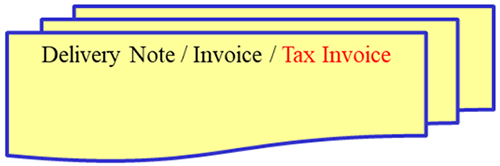
A Tax Invoice must contain prescribed information. If required information is missing or incorrect, the document may need to be replaced or corrected.
- The words “Tax Invoice”
- Issuer’s name, address, tax identification number, and head office/branch designation
- Customer’s name, address, tax identification number, and head office/branch designation
- Tax Invoice serial number
- Description or type of goods/services, quantity, and amount
- VAT amount shown separately
- Date of issuance
Next Article
In the December issue, we will explain Debit Notes (D/N), Credit Notes (C/N), and the concept of the tax point.


" + NS Solutions" is register trade mark of NS Solutions corporation.
Other description about company name and product name are trademark or register trade mark of each companies.