

The Role of ERP and MES Synergy in Digital Transformation (3)
Date : 11-06-2026
In the previous article, we explored how ERP and MES work together to achieve operational excellence. In this third installment, we will connect processes from the shop floor to executive management, enabling organizations to become truly data-driven and improving overall system efficiency.
End-to-End Visibility
Executives can monitor the status of every process in real time, reducing risks caused by incomplete data, such as inaccurate inventory levels.
Key benefits include:
- Increased transparency across all processes
- Enhanced accuracy in strategic decision-making
- Reduction of data silos
Data Silos refer to situations where data is stored separately across systems or departments, for example :
- The production team uses MES
- The planning team uses ERP
- The maintenance team operates its own system without automatic integration or data sharing
This fragmentation can lead to poor decision-making, as executives lack real-time visibility into actual operations, making it difficult to analyze the supply chain comprehensively.
Real-Time Decision Making
MES provides real production data, such as machine performance and output volume. ERP can then utilize this data to enable :
- Predictive maintenance
- Production planning adjustments
- Procurement planning optimization
As a result, organizations can :
- Reduce machine downtime
- Respond quickly to market demand
- Improve the accuracy of operational planning
Automation & Industry 4.0 Readiness
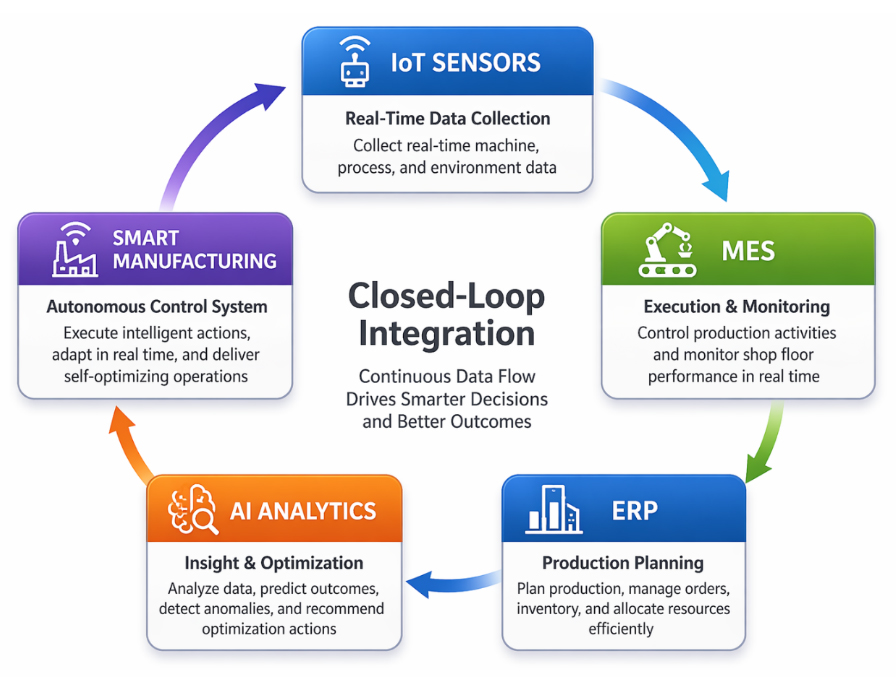
The integration of ERP and MES—such as using IoT sensors installed on machines—allows data to be transmitted to both systems. AI analytics can then process this data to optimize production efficiency, leading to Smart Manufacturing.
Smart Manufacturing enables :
- Automated systems that adapt based on real-time data
- Reduced dependence on human intervention
- Increased speed and production accuracy
Cost Reduction & Efficiency
MES helps reduce machine downtime and minimize losses from overproduction or underproduction. Meanwhile, ERP improves procurement, inventory management, and resource planning.
Together, MES and ERP :
- Reduce operational losses
- Improve efficiency
MES contributes by :
- Reducing downtime
- Minimizing overproduction and underproduction
- Enhancing quality control
ERP contributes by :
- Managing inventory effectively
- Optimizing procurement processes
- Improving resource planning
Overall impact :
- Total cost reduction
- Increased system ROI
- Greater supply chain agility
In the next and final article of this series, we will discuss system architecture design for flexible integration, along with approaches such as phased rollout and change management.


" + NS Solutions" is register trade mark of NS Solutions corporation.
Other description about company name and product name are trademark or register trade mark of each companies.