

The Role of ERP and MES Synergy in Digital Transformation (2)
Date : 07-05-2026
In the previous article we explained the roles of ERP and MES in modern manufacturing. In this 2nd article we would like to explore how ERP and MES work together for operational excellence.
Data Integration
MES captures real-time production data such as production volume, processing time, machine status, and product quality. This data reflects what is actually happening on the shop floor, which often differs from plans or estimated data stored in ERP systems.
By leveraging MES data, ERP can:
- Update inventory levels accurately, reducing discrepancies and stock mismatches
- Calculate actual production costs based on real performance instead of relying solely on standard costs
- Perform demand forecasting grounded in actual production efficiency and capacity
When ERP utilizes real operational data from MES, the gap between shop-floor reality and business systems is significantly reduced. This enables management and employees across the organization to share a single source of truth, leading to more accurate pricing decisions and sales planning.
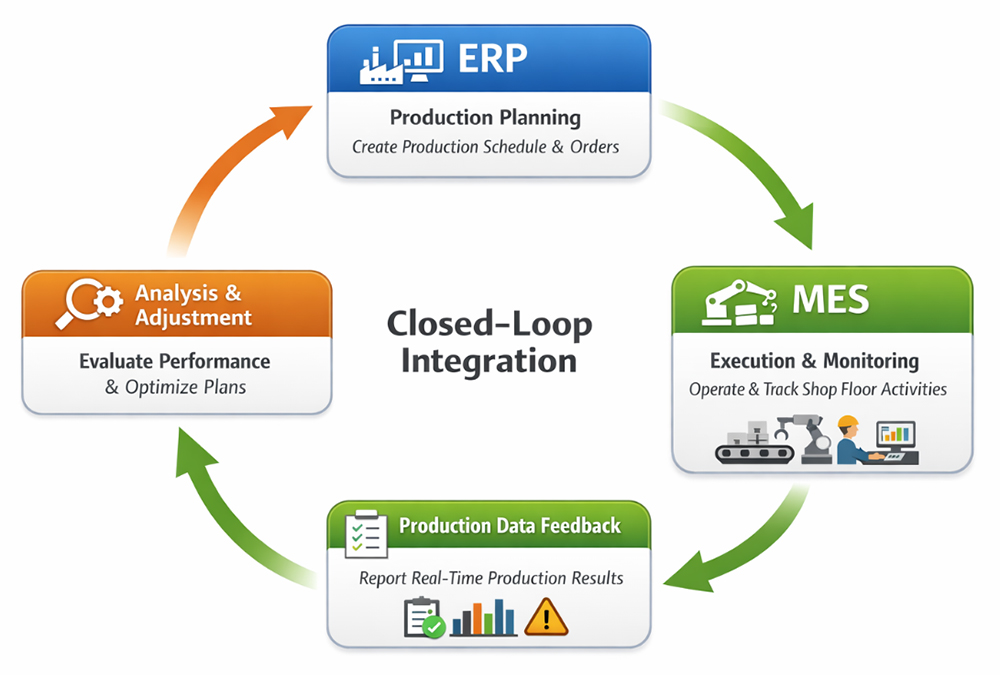
Closed-Loop Feedback
ERP defines production plans based on market demand and available resources, while MES reports actual production results—such as output, cycle time, and operational issues. This feedback allows ERP to continuously adjust production plans based on real-world conditions, creating a continuous improvement cycle.
The benefits include:
- Reduced waste and inefficiencies
- Greater flexibility in responding to customer demand
Examples of operational feedback :
| Actual issue | Root cause analysis | Feedback action |
| Production delays | Insufficient capacity | Adjust plans or add overtime |
| High downtime | Equipment issues | Initiate maintenance or revise plans |
| Low yield | Quality problems | Enhance quality control processes |
By automating this continuous improvement cycle, production planning is no longer based on assumptions but adapts dynamically to actual conditions. As a result, organizations can respond faster and smarter while minimizing accumulated losses.
Traceability & Compliance
MES records detailed production data at every step—such as batch numbers, operators, timestamps, and machines used—at a level of granularity that ERP alone cannot achieve.
ERP, on the other hand, manages documentation and reporting requirements for standards such as ISO, GMP, and FDA. In the event of a quality issue, full traceability can be established immediately. The system can identify affected raw material lot numbers and quickly initiate product recalls when necessary.
Auditors can easily review historical production records, reducing regulatory and legal risks while increasing trust among customers and business partners. When used effectively, traceability becomes not a burden, but a strategic competitive advantage.
Resource Optimization
ERP excels at enterprise-level planning and resource allocation, including:
- Procurement planning for raw materials aligned with production schedules
- Workforce planning at department or production-line levels
- Budgeting and cost control based on planned targets
- Mid- to long-term production planning
MES complements this by monitoring actual resource utilization at the operational level, such as:
- Actual machine runtime versus idle time
- Real production rates per hour
- Operator productivity at each workstation
- Reasons for stoppages, delays, and scrap
When ERP and MES data are fully integrated, ERP can identify which plans consume excessive resources, while MES highlights the true bottlenecks on the shop floor.
For example, even if production is planned at 120% capacity, high downtime, frequent changeovers, material shortages, or quality holds may prevent targets from being achieved.
Using real operational data, ERP can accurately adjust production plans, shift schedules, and task assignments. This enables organizations to:
- Reduce unnecessary resource usage
- Improve production efficiency
- Lower manufacturing costs
- Increase throughput and output
- Optimize resource utilization
- Reduce unit costs
- Improve OEE (Overall Equipment Effectiveness)
In addition, this integrated approach supports capacity expansion without unnecessary capital investment.
In the next column of this series, we will delve deeper into the effects of integrating ERP and MES, and discuss how it can contribute to achieving digital transformation in modern manufacturing.


" + NS Solutions" is register trade mark of NS Solutions corporation.
Other description about company name and product name are trademark or register trade mark of each companies.